

In the news November 2024
Adam Tromblay, General Manager
The economy is a dynamic force, and new trends are emerging. Several factors are contributing to potential price increases in the coming months, including fluctuations in energy costs from our suppliers.
Inflation is on the rise
Economic signals suggest we may be facing another period of rising inflation. While we recently enjoyed a short period of declining inflation, several factors are contributing to renewed price pressures. Energy costs, particularly for gasoline and oil, are climbing significantly which ultimately affects electricity as well. Ongoing supply chain disruptions continue to affect the availability and cost of many goods, putting upward pressure on prices. Furthermore, strong consumer demand, fueled by pent-up spending desires, is adding to the inflationary trend. As these factors combine, consumers should prepare for higher prices on a range of goods and services in the coming months and into 2025.
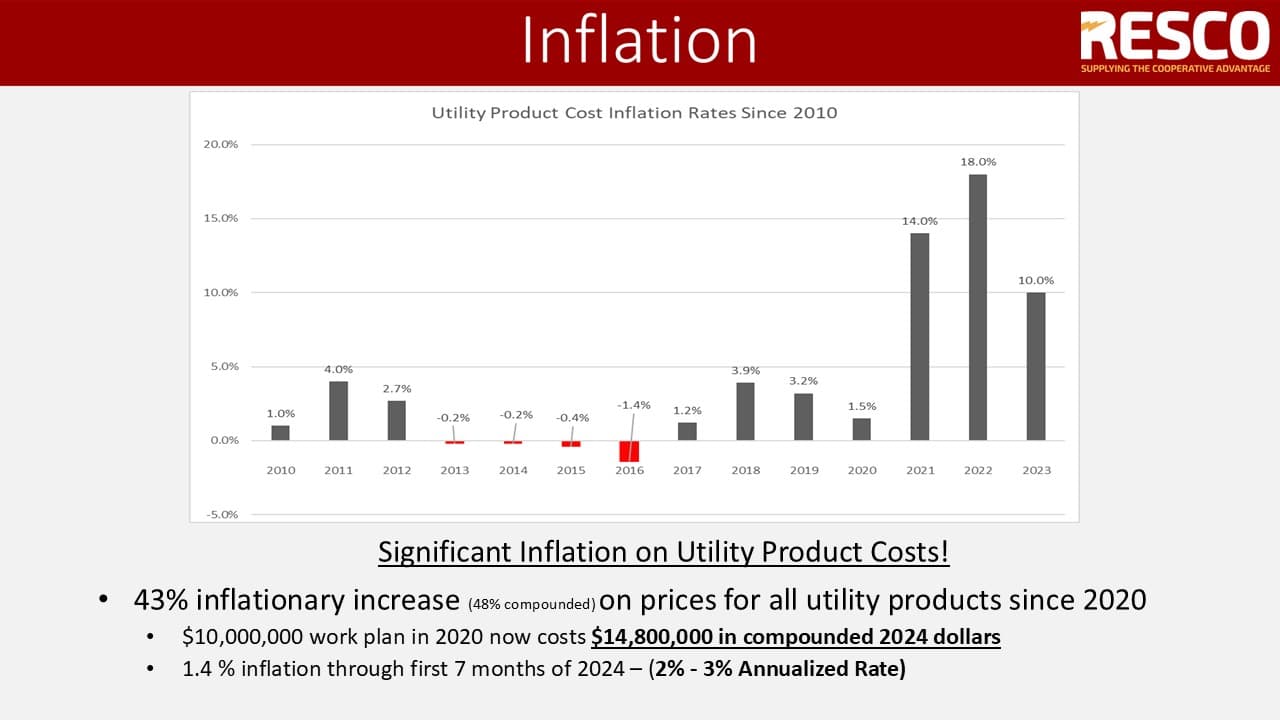
Our partners at Rural Electric Supply Cooperative (RESCO) have recently shared with us a chart about the inflation rate increases.
During the first seven months of 2024, RESCO saw a 1.4% inflation rate, with an estimated annualized rate of 2-3%. Since 2020, there has been a 43% inflationary increase (48% compounded) on prices for all utility products. This means that a $10,000,000 work plan in 2020 now costs $14,800,000 in compounded 2024 dollars.
The chart below shows the Utility Product Cost Inflation Rates since 2010. As you can see, there have been some years with negative inflation (deflation), but the overall trend is for prices increasing.
As consumers, we have already observed a noticeable increase in our daily expenses at grocery and retail outlets. The electric industry also appears to be preparing for a challenging period ahead, marked by rising costs that further complicate long term financial matters. Inflation has already driven up the prices of essential materials like transformers, cables and poles, significantly impacting operational expenses. Simultaneously, we are anticipating higher power costs from our suppliers, which could result in increased rates and adjustments in the future—just for the general cost of electricity. These cumulative pressures create a substantial burden on our budgets.
We want to assure our members that we are continually looking for efficiencies and better ways to run our cooperative, taking an active approach to mitigate the effects of inflation and rising costs as much as possible.