
May Podcast - Costs are Rising
Nobles Cooperative Electric CFO Dave Dorpinghaus discusses rising equipment and operating costs, margins, and the long-term planning required to continue delivering reliable power to members.
What does inflation mean for your electric cooperative? In this episode, CFO Dave Dorpinghaus discusses rising costs for equipment, materials, and operations — and how Nobles Cooperative Electric continues working to provide reliable service while planning responsibly for the future.
Rising Costs, Margins & Keeping Rates Stable
Podcast Transcript with Dave Dorpinghaus, Chief Financial Officer at Nobles Cooperative Electric
Hi everyone, this is Dave Dorpinghaus, Chief Financial Officer at Nobles Cooperative Electric.
Today I want to take a few minutes to talk about something we’re all feeling right now—rising costs—and what that means to you.
You’ve probably noticed costs in your own life. Whether it’s groceries, fuel, home improvements, or equipment on the farm… things simply cost more than they used to.
And the same is true for us here at the co-op.
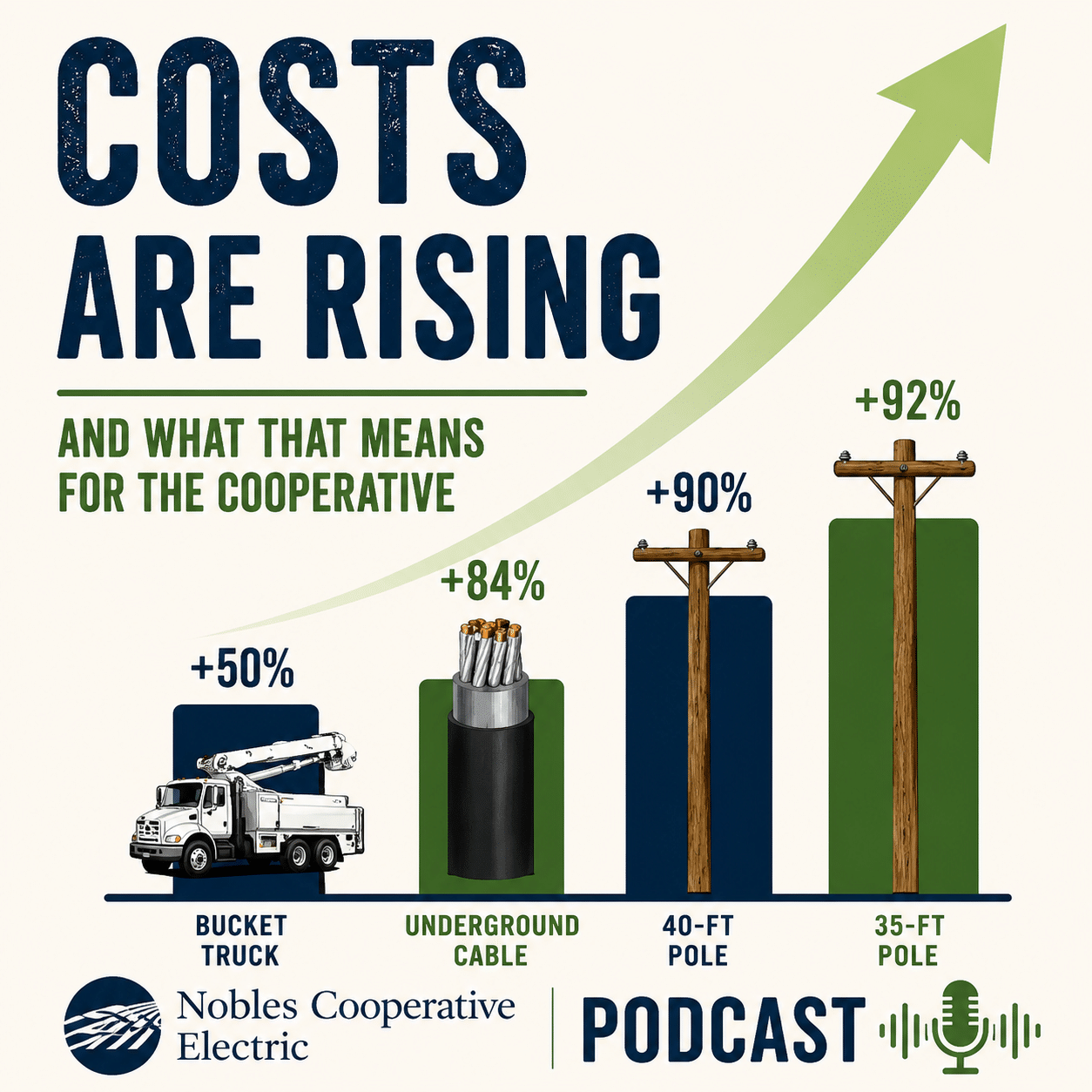
For example, a digger truck that cost around $295,000 in 2021 now runs about $446,000—that’s more than a 50% increase.
Poles have nearly doubled in cost. A 35-foot pole has gone from $371 to $713, and a 40-foot pole from $468 to $888.
Underground cable has jumped from about $2.07 per foot to $3.81.
Even the basics—like printing and mailing—have gone up. We are mailing about 24% fewer bills and newsletters thanks to members using SmartHub and choosing online delivery, but postage alone has still increased 42%, and overall mailing and printing costs are up about 25%.
So costs are rising across the board.
What Does That Mean for Members?
So what does that mean for you as a member?
It means we’re seeing those same cost pressures behind the scenes as we work to maintain the system that delivers your power every day.
At the same time, the amount you pay per kilowatt-hour has only increased about 24% since 2020. That’s significantly lower than the pace of these cost increases.
Most of the costs I just mentioned are long term assets which are used for a period of 10 to 30+ years. The majority of our system was purchased at much lower prices than they are being purchased for today. Over time, the increased cost of upgrading these assets will potentially cause rates to increase in the future.
Understanding Margins
The second part I want to discuss is our margin.
Now, “margin” can sound like a business term, but at your cooperative, it’s really pretty simple.
Margins are the amount left over after we pay all of our expenses—things like power supply, maintenance, member services, and day-to-day operations.
They help us build and maintain infrastructure, make the debt payments, cover unexpected costs, and keep the system financially strong.
Healthy margins are what allow us to plan ahead instead of reacting to problems.
They give us the ability to:
- Replace aging equipment before it fails
- Respond to storms and outages
- Invest in reliability improvements across the system
And over time, margins are returned to you as capital credits.
So when costs rise faster than revenue, we have to be very thoughtful in how we respond—because those margins can get squeezed.
Without strong margins, we have less flexibility—not only to maintain and invest in the system, but also to return capital credits back to our members over time.
We don’t replace equipment early “just because”—it has to be necessary. Our equipment first and foremost needs to safe for our crew members, but it also has to make financial sense.
Our Focus Moving Forward
Our focus remains the same—providing reliable power at the lowest cost possible.
And just as importantly, making decisions today that keeps your cooperative strong for the long run.
We know personally some of those same pressures are affecting your households and operations, too. And we take seriously our responsibility to manage your cooperative in a way that keeps rates as stable as possible while continuing to deliver the service you depend on.
We live and work right here in the same communities we serve — and we’re members too. So when we talk about keeping rates stable and making long-term decisions for the cooperative, those decisions affect us personally just like they affect our members.
Thanks for taking a few minutes to listen, and as always, thank you for being a member of Nobles Cooperative Electric. Please reach out if you have any questions.